

Commercial Building Energy Storage May Be the Grid's Biggest Opportunity
Energy leader Jigar Shah recently highlighted a challenge facing the PJM region: a projected 10,000 MW capacity gap and a growing realization that new generation alone can't be deployed quickly enough to meet rising demand.
For years, the energy industry has focused primarily on what Shah calls the "hard path" to meeting demand, which involved building more power plants, more transmission lines, and more centralized infrastructure. Those investments are indeed critical, but as demand accelerates, especially from data centers and AI infrastructure, the industry must remember that the fastest megawatt to deploy is often the one you don't need to generate.
That’s why commercial buildings represent one of the largest untapped distributed energy resources available to address grid capacity shortages in the United States.
Commercial Buildings Can Help Solve Grid Capacity Shortfalls
Energy demand is increasing faster than many regional grids anticipated. At the same time, resilience concerns are growing for businesses facing more frequent weather disruptions, aging infrastructure, and rising utility costs. The result of these challenges coinciding is an opportunity to align business interests with grid needs.
Restaurants, retail stores, hotels, gyms, healthcare facilities, and other small-to-mid-sized commercial buildings consume significant amounts of energy every day, spending billions annually. Historically, these buildings have been viewed only as customers of the grid—while deployment of energy efficiency, renewables, and battery storage have been focused on residential and hyperscalers.
But now, there is an opportunity for commercial buildings to become active participants in the grid with energy storage, advanced controls, demand response programs, and virtual power plants (VPPs) that lower businesses’ operating costs while also supporting grid reliability. These solutions enable commercial buildings to reduce their own energy demand, shift load, or even provide stored energy during peak periods.
When aggregated across thousands of sites, SMBs can function as distributed energy resources capable of delivering meaningful capacity back to the grid.
How Can Commercial Buildings Support Grid Reliability?
Commercial buildings support grid reliability through energy efficiency upgrades, battery storage systems, demand response participation, and virtual power plants. When aggregated across thousands of sites, these distributed energy resources can reduce peak demand and provide flexible capacity back to the grid.
Why Battery Storage Deployment Remains Challenging
Batteries are the key to a more stable energy future. As of mid-2026, the U.S. has nearly 52 GW of utility-scale battery storage, which has been growing 70% a year for three years in a row. But accessing the benefits of commercial building energy storage isn’t always easy. For the average business managing labor shortages, operational costs, and customer experience, evaluating battery storage is rarely the top priority. Plus, often even when it is, they may lack the capital required to implement these solutions.
In his post, Jigar Shah mentions four main barriers to battery deployment: money, complexity, time and risk.
Most organizations don't have:
- Capital budget allocated for energy infrastructure
- In-house expertise on battery installation, interconnection, and VPPs
- Time to manage energy storage installation and ongoing management
- The ability to take on the performance risk of unfamiliar technology
Plus, to make an impact big enough to help the grid, there needs to be more than piecemeal adoption. Solutions need to be deployed at scale and to be able to work together strategically.
Shah says that the solution to these barriers is that commercial businesses need someone to partner with.
“So what would that somebody look like? They'd front the capital, handle the whole building, show up after install, and have the scale to keep costs down,” he notes.
“That's exactly the model Budderfly has spent years building, and now it's adding batteries.”
While other energy companies target residential and hyperscalers, Budderfly is the only company focused on making battery storage accessible to SMBs.
Why Energy Efficiency and Battery Storage Work Better Together
One of the most important insights often missing from conversations about commercial building energy storage is that batteries perform best as part of a larger building strategy.
A battery cannot solve every energy challenge on its own. If a facility is operating with aging HVAC systems, inefficient lighting, and outdated controls, it will likely need to improve performance before optimizing further with energy storage.
Efficiency and storage are complementary solutions that help deliver the best outcomes together.
The most valuable commercial buildings of the future will combine:
- Energy efficiency upgrades
- Intelligent controls
- Demand response participation
- Battery storage
- Renewable energy where appropriate
- Ongoing operations and maintenance
Together, these technologies create buildings that consume less energy, cost less to operate, and provide greater value to the grid.
Why Are Commercial Building Batteries Important?
Commercial building batteries allow businesses to store electricity during low-demand periods and discharge energy during peak demand. This helps lower operating costs, improve resilience, and support grid reliability.
How Budderfly Helps Commercial Buildings Access Batteries
The opportunity in front of the PJM region—and across the U.S.—to address growing energy demand is enormous. The technology developed in recent years now means 53 million commercial buildings could help deliver flexibility back to the grid.
Yet to tap this potential, the industry must make participation simple enough for business owners to say yes by removing obstacles and risk.
For years at Budderfly, we've helped organizations improve energy performance by addressing efficiency, equipment modernization, data tracking, and ongoing service under our award-winning Energy-as-a-Service model. As distributed energy resources become an increasingly important part of grid reliability, we believe the same principle applies: customers shouldn't have to become energy experts to capture the benefits.
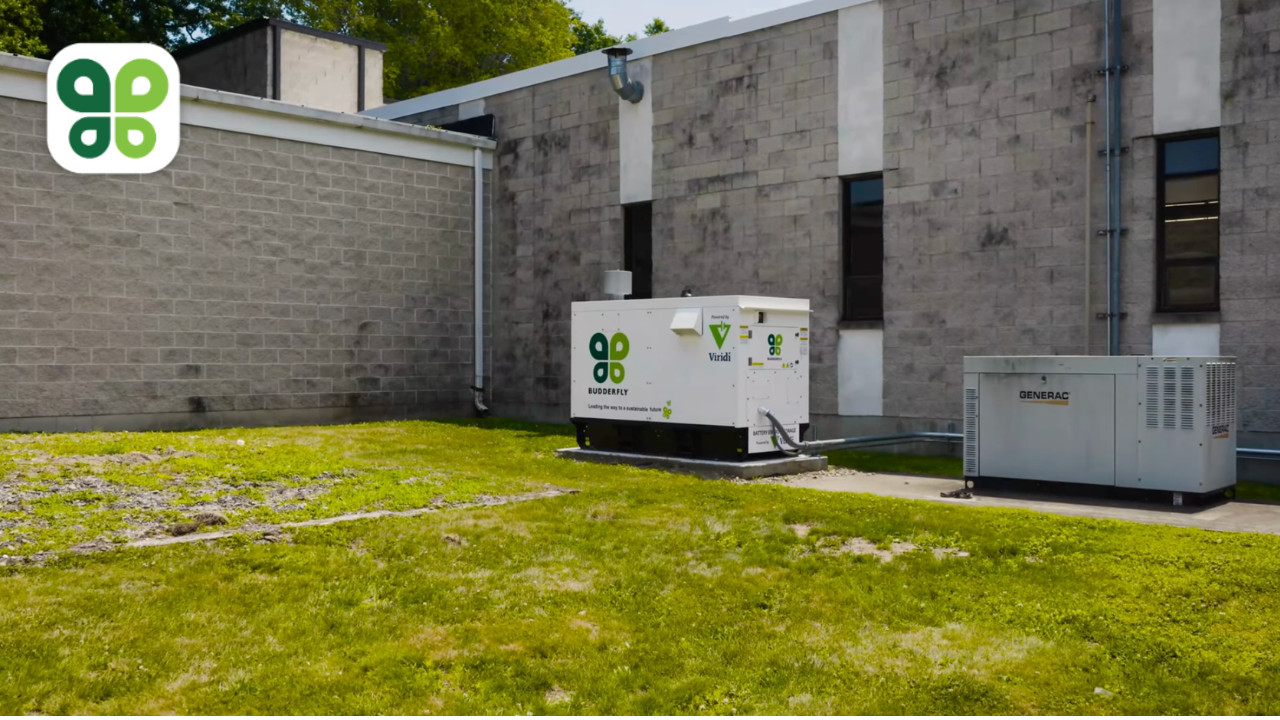
That’s why we’re going big on batteries. In June, we announced our nationwide deployment initiative with Viridi to bring their commercial battery energy storage systems to 100 Budderfly-managed commercial sites across the United States.
Batteries seamlessly integrate into Budderfly’s model alongside energy efficiency upgrades, solar, and intelligent controls and are a critical part of our Energy Lake. Energy Lake is Budderfly's network of distributed energy resources, including batteries, efficiency assets, and intelligent controls, that can be aggregated across thousands of commercial sites and dispatched to support grid reliability and reduce peak demand. It solves one of the grid’s most important challenges: timing—getting energy where it's needed, when it's needed.
To close capacity gaps, improve resilience, and lower costs, the industry must recognize that some of the most valuable energy assets in America are already connected to the grid today.
“The industry needs to deploy $1B of batteries by the end of 2027 to meet the goals of the hyperscalers,” Shah said in his recent post.
Budderfly is helping by focusing our efforts on bringing storage to commercial businesses, with a coordinated layer of flexibility the U.S. grid needs to enter the next phase of the energy transition.
Frequently Asked Questions
How do commercial buildings support the electric grid?
Commercial buildings can support the grid through energy efficiency improvements, battery storage systems, demand response participation, and virtual power plants that reduce peak demand and provide flexible capacity.
What are distributed energy resources?
Distributed energy resources (DERs) are decentralized energy assets such as batteries, smart controls, solar energy systems, and flexible building loads that help balance electricity supply and demand.
Why is commercial building battery storage important?
Commercial building battery storage helps businesses lower energy costs, improve resilience, and provide energy flexibility that supports overall grid reliability.
What is a virtual power plant?
A virtual power plant (VPP) is a coordinated network of distributed energy resources that can be operated as a single resource to support utilities and grid operators.