---
title: "Q&A: Derek Moskal on Energy Workforce Gaps, Safety & Scaling"
description: Budderfly VP Derek Moskal discusses workforce shortages, safety, partnerships, and how managed energy infrastructure delivers long‑term savings.
image: https://blog.budderfly.com/hubfs/Website%20Header%20Images%20-%201280x720-3.png
---
[Careers](https://omsbdrflyprd.wpengine.com/careers/)
[](https://cta-redirect.hubspot.com/cta/redirect/20472728/b14da822-cd99-48ce-b039-a18781490a06)
[](https://omsbdrflyprd.wpengine.com/)
- [Energy as a Service](https://www.budderfly.com/energy-service/)
- [Equipment](https://www.budderfly.com/energy-service/equipment/)
- [Smart Technology Monitoring](https://www.budderfly.com/our-technology/)
- [How We Innovate](https://www.budderfly.com/energy-service/how-we-innovate/)
- [Measuring & Billing Technology](https://www.budderfly.com/energy-service/measuring-billing-technology/)
- [Who We Serve](https://www.budderfly.com/the-budderfly-effect/)
- [Restaurants](https://www.budderfly.com/the-budderfly-effect/fast-casual-restaurants/)
- [Corporate & Enterprise](https://www.budderfly.com/the-budderfly-effect/enterprise/)
- [Hospitality](https://www.budderfly.com/the-budderfly-effect/hospitality/)
- [Healthcare & Fitness](https://www.budderfly.com/the-budderfly-effect/healthcare-fitness/)
- [Schools & Universities](https://www.budderfly.com/the-budderfly-effect/schools-universities/)
- [Retail](https://www.budderfly.com/the-budderfly-effect/chain-retail/)
- [Convenience Stores](https://www.budderfly.com/the-budderfly-effect/convenience-stores/)
- [Manufacturing](https://www.budderfly.com/the-budderfly-effect/manufacturing/)
- [Resources](https://blog.budderfly.com/)
- [Blog](https://blog.budderfly.com/)
- [Case Studies](https://case-studies.budderfly.com/)
- [Customer Testimonials](https://www.budderfly.com/resources/customer-testimonials/)
- [Thought Leadership](https://info.budderfly.com/)
- [News](https://news.budderfly.com/)
- [About](https://www.budderfly.com/about/)
- [Executive Team](https://www.budderfly.com/executive-team/)
- [Leadership](https://www.budderfly.com/leadership/)
- [Board of Directors](https://www.budderfly.com/board-of-directors/)
- [Mission](https://www.budderfly.com/about/mission/)
[](https://cta-redirect.hubspot.com/cta/redirect/20472728/f27e5725-ac20-4a22-8db5-60c912879eb9)
- [Energy as a Service](https://www.budderfly.com/energy-service/)
- [Equipment](https://www.budderfly.com/energy-service/equipment/)
- [Smart Technology Monitoring](https://www.budderfly.com/our-technology/)
- [How We Innovate](https://www.budderfly.com/energy-service/how-we-innovate/)
- [Measuring & Billing Technology](https://www.budderfly.com/energy-service/measuring-billing-technology/)
- [Who We Serve](https://www.budderfly.com/the-budderfly-effect/)
- [Restaurants](https://www.budderfly.com/the-budderfly-effect/fast-casual-restaurants/)
- [Corporate & Enterprise](https://www.budderfly.com/the-budderfly-effect/enterprise/)
- [Hospitality](https://www.budderfly.com/the-budderfly-effect/hospitality/)
- [Healthcare & Fitness](https://www.budderfly.com/the-budderfly-effect/healthcare-fitness/)
- [Schools & Universities](https://www.budderfly.com/the-budderfly-effect/schools-universities/)
- [Retail](https://www.budderfly.com/the-budderfly-effect/chain-retail/)
- [Convenience Stores](https://www.budderfly.com/the-budderfly-effect/convenience-stores/)
- [Manufacturing](https://www.budderfly.com/the-budderfly-effect/manufacturing/)
- [Resources](https://blog.budderfly.com/)
- [Blog](https://blog.budderfly.com/)
- [Case Studies](https://case-studies.budderfly.com/)
- [Customer Testimonials](https://www.budderfly.com/resources/customer-testimonials/)
- [Thought Leadership](https://info.budderfly.com/)
- [News](https://news.budderfly.com/)
- [About](https://www.budderfly.com/about/)
- [Executive Team](https://www.budderfly.com/executive-team/)
- [Leadership](https://www.budderfly.com/leadership/)
- [Board of Directors](https://www.budderfly.com/board-of-directors/)
- [Mission](https://www.budderfly.com/about/mission/)
[Careers](https://omsbdrflyprd.wpengine.com/careers/)
[](https://cta-redirect.hubspot.com/cta/redirect/20472728/b14da822-cd99-48ce-b039-a18781490a06)
May 01, 2026
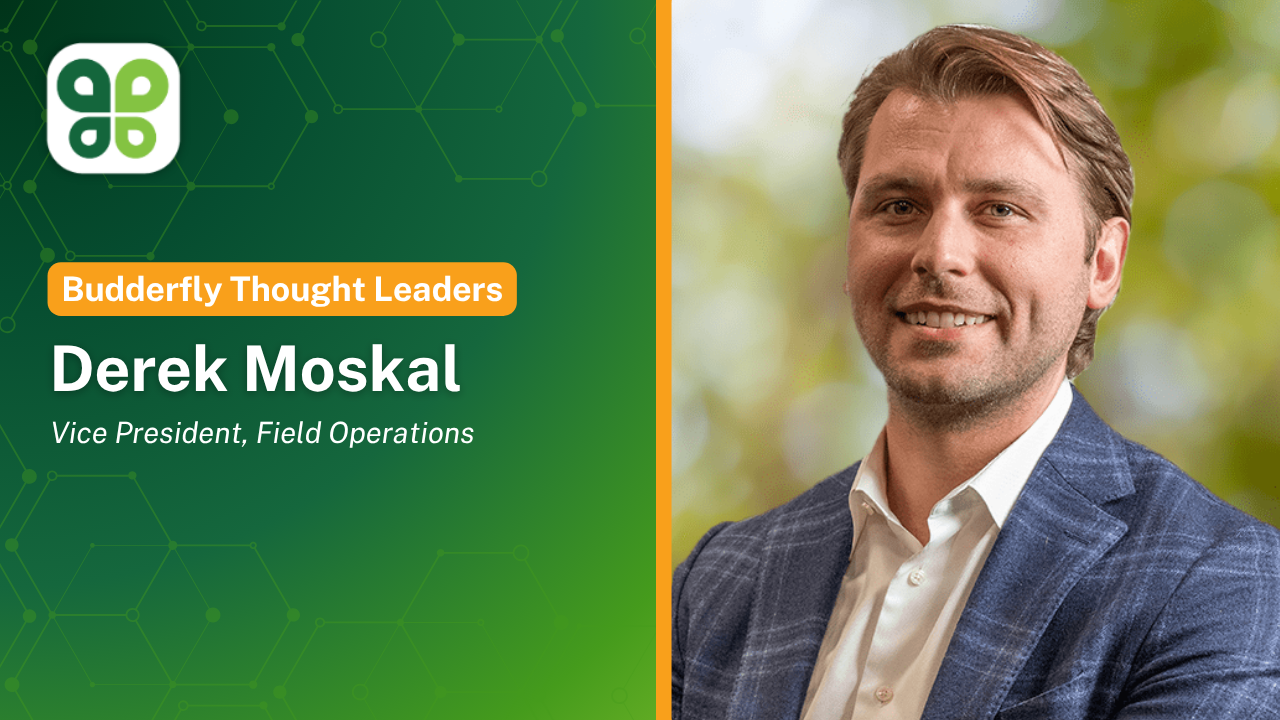
# Q&A: Derek Moskal on Energy Workforce Gaps, Safety & Scaling
*Interview with Derek Moskal, Vice President of Field Operations at Budderfly, an energy management company serving commercial mid*‑*market buildings across the United States.*
Derek Moskal, Budderfly’s Vice President of Field Operations, is a key player who works on our business from many different angles. His role gives him unique expertise and insight about not just Budderfly, but the [energy management](https://www.budderfly.com/energy-service/) industry and its challenges.
We spoke with him to glean some of these learnings: including what is needed to solve the labor and skills gap, how Budderfly builds strong partnerships, why young workers should be excited by construction and energy infrastructure [careers](https://www.budderfly.com/careers/), and more.
Read the Q&A to get some great learnings and to see what sets Budderfly apart.
## **Could you explain your role at Budderfly?**
My role is very much a blend of strategic planning and hands-on execution. Budderfly is scaling quickly, and in a fast-growing environment like ours, you can’t operate purely at 30,000 feet. I spend a lot of time making sure Budderfly’s long-term strategy is grounded in what’s actually happening in the field.
In a typical week, that means working closely with our sales team to translate market demand into executable forecasts, disciplined capital deployment, and predictable margins.
I also spend time with both new and existing partners to keep everyone aligned operationally. As we grow, synchronization across teams and partners becomes even more important.
Finally, I’m constantly [monitoring performance](https://www.budderfly.com/our-technology/) — looking at operational results, identifying where we can improve cost, throughput, or savings, and making sure we act on those insights quickly and thoughtfully.
## **What do you think are some of the more challenging issues facing the Energy Management Solutions industry today?**
A key challenge for the industry is the labor and skills gap, particularly as projects grow in complexity and capital spend. High-efficiency HVAC systems, EMS/BMS platforms, and integrated energy solutions require specialized expertise, and there simply aren’t enough experienced technicians to support deployment at the pace the market demands.
To address this, we built an internal workforce, called “Energy Force” to ensure quality, consistency, and discipline in areas we can train for.
At the same time, we’re thinking beyond our own needs and have [partnered with trade schools](https://info.budderfly.com/school-partnerships) to help strengthen the broader talent pipeline. This isn’t just a Budderfly challenge, it’s industry-wide. If energy efficiency is going to scale, workforce development must scale with it.
## **What is Budderfly doing as a company to attract and develop talent?**
Our growth is absolutely driven by the people behind the platform. In a talent-constrained market, Budderfly takes the view that you can’t just compete for talent — you have to help build it.
Internally, we invest heavily in development. That includes structured training programs, learning modules, shadowing opportunities, and clearly defined career pathways so employees can grow as the company grows.
Externally, we’re focused on widening the talent pipeline. We offer tuition reimbursement for employees continuing their education, and we’ve partnered with trade and technical schools to strengthen hands-on training in energy technologies. Through these programs, participants receive hands‑on training with advanced technologies such as high‑performance HVAC systems, smart thermostats, and IoT devices. By [giving schools access to equipment from partners like Fujitsu, Carrier, and Lennox](https://www.achrnews.com/articles/155304-bridging-the-skilled-trades-gap-to-accelerate-the-energy-transition), we’re helping elevate their technical capabilities while creating a stronger workforce for the industry overall.
## **The Budderfly team works diverse hours in all types of conditions. What are some of the steps that Budderfly takes to ensure safety on and off the field?**
We follow a standardized EHS program aligned with OSHA requirements, supported by ongoing training and continuous education for both internal teams and external partners. These efforts ensure everyone working on Budderfly projects has the guidance, tools, and protocols needed to operate safely in any environment.
## **How does Budderfly ensure long-term energy savings for customers?**
Our customer contracts typically span 10 years, and our incentives stay aligned throughout that term because we only earn back our investment by reducing our customers’ energy usage. We monetize our customers’ energy waste.
We accomplish this by treating energy as managed infrastructure, not a one-time retrofit. Every site is monitored through our centralized platform, which gives us real‑time visibility into how each site is performing. That allows us to continuously adjust schedules, tune equipment, and uncover new savings opportunities.
Because we own and operate the equipment, we handle maintenance, repairs, and technology upgrades proactively. As new solutions, like heat pumps, advanced controls, solar, geothermal, or refrigeration optimization become economically viable, we integrate them into existing portfolios. Our combination of ownership, monitoring, and ongoing optimization ensures savings are not just achieved at installation, but sustained and improved over time.
## **How does Budderfly approach evaluating suppliers and subcontractors? What are you looking for?**
Strong partnerships are foundational to our model because we own and operate the infrastructure we deploy. For installation partners, we follow a disciplined process that includes rigorous vetting, structured onboarding, and hands-on training. Once a partner is in our network, the work doesn’t stop there. We track performance through cross-functional KPIs — safety, quality, timeliness, and customer outcomes — and we share those results with partners. That feedback loop drives continuous improvement on both sides.
On the supplier side, the lens is similar but more product-focused. We prioritize long-term relationships built around quality, reliability, cost discipline, and delivery consistency. Given the scale at which we operate, supply chain stability matters just as much as price.
## **What are the two or three things that you feel differentiate Budderfly** **as a leader in the Energy Management Solutions industry?**
Three things that set Budderfly apart are:
1\. Our focus on the commercial mid-market. We are purpose-built for buildings under 200,000 square feet — a segment that has historically been underserved due to fragmentation and limited access to capital. By standardizing performance, we’ve built a model specifically designed to scale across multi-site portfolios.
2\. Full ownership and accountability. We own, finance, install, and operate all behind-the-meter upgrades. Customers work with one partner, on one contract, with one monthly invoice. That removes complexity and ensures performance accountability from day one through year ten.
3\. Continuous innovation, not one-time retrofits. Energy systems evolve, and so do we. We continuously integrate technologies such as heat pumps, advanced controls, solar, battery storage, and refrigeration optimization as they become practical and cost-effective. Because we manage these assets long term, we can deploy new measures over time rather than locking customers into static solutions.
By combining financing, engineering, construction execution, and long-term operations under one model, we deliver predictable savings while simplifying what is typically a fragmented and capital-intensive process.
## **What advice would you impart on a young person interested in energy solutions as a career?**
Energy infrastructure is far more dynamic than many people realize. It’s a field that’s constantly evolving—technologically, operationally, and economically—and that creates real opportunity for people who are willing to learn and adapt.
My biggest advice is to embrace continuous education. Tools like AI, advanced controls, and smart building systems are becoming part of everyday workflows. The professionals who understand both the physical work and the digital tools will be incredibly valuable.
I attribute my learnings not just to individuals over time, but also to the companies I’ve worked for. Prior to Budderfly, I spent time in Restaurant Development at McDonald’s Corporate, and before that in Energy & Facilities Management at Macy’s Corporate. I’ve learned a tremendous amount from people at every level of the business, not just senior leadership. That’s a big reason why I still enjoy being in the trenches with my teams today. There’s always something to learn at every level, every day.
I’d also encourage young people to see this field as more than just a job site. Construction today intersects with sustainability, energy resilience, and economic development. You’re not just building structures — you’re shaping how communities operate.
## **Knowing what you know now, if you were to go back in time and run into the “newbie” version of yourself, just entering the industry, would you have any advice for the younger you?**
I was never one to shy away from asking questions or challenging the status quo. I’d tell my younger self to keep doing exactly that, and to continue learning from everyone around you, not just those above you. That curiosity drives a deeper level of understanding and often sparks innovation.
I’d also emphasize the importance of developing an early understanding of AI and its benefits to the business. Leveraging it for data, analysis, KPIs, and other operational insights will help you make simpler decisions faster and free up time to focus on higher‑value work across the organization.
---
### Recent Posts
#### [5 Key Insights About How Sustainability Impacts Business Performance](https://blog.budderfly.com/new-york-climate-week-leadership-impact-forum-al-subbloie)
Oct 01, 2026 09:59:48 AM
#### [What Is Holding Back the Energy Transition? 10 Challenges Facing Building Owners](https://blog.budderfly.com/what-is-holding-back-the-energy-transition-10-challenges-facing-building-owners)
Sep 25, 2026 09:05:54 AM
#### [CapEx, Debt, or EaaS? The CFO’s Guide to Energy Upgrades](https://blog.budderfly.com/cfo-guide-off-balance-sheet-energy-upgrades-eaas)
Sep 14, 2026 10:02:49 AM
### Contact us
Email: [info@budderfly.com](mailto:info@budderfly.com)
Phone: [(855) 299-1334](tel:(855)%20299-1334)
Address: 2 Trap Falls Road, Suite 300
Shelton, CT 06484
### Get updates straight to your inbox:
Subscribe to receive regular updates straight to your inbox.
[](https://omsbdrflyprd.wpengine.com/)
2 Trap Falls Road, Suite 310
Shelton, CT 06484
[(855) 299-1334](tel:855-299-1334)
[](https://cta-redirect.hubspot.com/cta/redirect/20472728/a6496eea-1348-4b02-942b-42039cf68f2c)
-
-
-
-
- - [Energy as a Service](https://omsbdrflyprd.wpengine.com/energy-service/)
- [Who We Serve](https://omsbdrflyprd.wpengine.com/the-budderfly-effect/)
- [Resources](https://omsbdrflyprd.wpengine.com/resources/)
- [Blog](https://blog.budderfly.com/)
- - [In the News](https://news.budderfly.com/)
- [Case Studies](https://case-studies.budderfly.com/)
- [About](https://omsbdrflyprd.wpengine.com/about/)
- [Careers](https://omsbdrflyprd.wpengine.com/careers/)
[](https://www.budderfly.com/)
© 2026 Budderfly
- [Privacy Policy](https://omsbdrflyprd.wpengine.com/privacy-policy/)
- [Accessibility Statement](https://omsbdrflyprd.wpengine.com/accessibility-statement/)
- [Sitemap](https://omsbdrflyprd.wpengine.com/sitemap/)
- [Patents](https://omsbdrflyprd.wpengine.com/patents/)
[](https://cta-redirect.hubspot.com/cta/redirect/20472728/b14da822-cd99-48ce-b039-a18781490a06)
```json
{
"@context" : "https://schema.org",
"@type" : "BlogPosting",
"author" : {
"@type" : "Person",
"name" : "Budderfly",
"url" : "https://blog.budderfly.com/author/budderfly"
},
"dateModified" : "2026-05-01T17:05:39.821Z",
"datePublished" : "2026-05-01T17:05:39.000Z",
"headline" : "Q&A: Derek Moskal on Energy Workforce Gaps, Safety & Scaling",
"image" : [ "https://blog.budderfly.com/hubfs/Website%20Header%20Images%20-%201280x720-3.png" ],
"mainEntityOfPage" : {
"@id" : "https://blog.budderfly.com/qa-derek-moskal-on-energy-workforce-gaps-safety-scaling",
"@type" : "WebPage"
},
"publisher" : {
"@type" : "Organization",
"logo" : {
"@type" : "ImageObject",
"url" : "https://blog.budderfly.com/hubfs/Budderfly%20logos/Budderfly%20Logo%20w%20tage-2%20copy.png"
},
"name" : "Budderfly"
}
}
```
```json
{
"@context" : "https://schema.org",
"@type" : "FAQPage",
"mainEntity" : [ {
"@type" : "Question",
"acceptedAnswer" : {
"@type" : "Answer",
"text" : "Gyms often run long hours, have high ceilings, and carry heavy humidity loads from showers and workouts—forcing HVAC and ventilation to run harder than most businesses."
},
"name" : "Why is my gym’s electricity bill so high compared to other businesses?"
}, {
"@type" : "Question",
"acceptedAnswer" : {
"@type" : "Answer",
"text" : "Lighting can be a major slice of a gym’s energy use. LEDs cut lighting consumption significantly and reduce heat, which can also lower air-conditioning demand."
},
"name" : "How much can LED lighting actually save a fitness center?"
}, {
"@type" : "Question",
"acceptedAnswer" : {
"@type" : "Answer",
"text" : "Yes—some models (like Energy-as-a-Service) fund high-efficiency HVAC replacements upfront and are paid back through measured energy savings instead of CapEx."
},
"name" : "Can I upgrade my gym’s HVAC without a huge upfront payment?"
}, {
"@type" : "Question",
"acceptedAnswer" : {
"@type" : "Answer",
"text" : "Pools can drive energy costs due to constant filtration and heating. Variable-speed drives plus smart monitoring can reduce pump and heating energy without sacrificing comfort."
},
"name" : "How do swimming pools impact energy costs?"
}, {
"@type" : "Question",
"acceptedAnswer" : {
"@type" : "Answer",
"text" : "Peak demand charges are based on your highest usage spike in a billing cycle. Monitoring and load management can help smooth spikes and reduce demand-related costs."
},
"name" : "What are \"Peak Demand\" charges and how do gyms avoid them?"
} ]
}
```