---
title: How UConn Students Helped Budderfly Solve Lighting Efficiency Challenges
description: Budderfly collaborated with a group of seniors from UConn’s Computer Science Engineering (CSE) program to drive energy savings at commercial businesses.
image: https://blog.budderfly.com/hubfs/Blog-UConn-Project-1280x720.png
---
[Careers](https://omsbdrflyprd.wpengine.com/careers/)
[](https://cta-redirect.hubspot.com/cta/redirect/20472728/b14da822-cd99-48ce-b039-a18781490a06)
[](https://omsbdrflyprd.wpengine.com/)
- [Energy as a Service](https://www.budderfly.com/energy-service/)
- [Equipment](https://www.budderfly.com/energy-service/equipment/)
- [Smart Technology Monitoring](https://www.budderfly.com/our-technology/)
- [How We Innovate](https://www.budderfly.com/energy-service/how-we-innovate/)
- [Measuring & Billing Technology](https://www.budderfly.com/energy-service/measuring-billing-technology/)
- [Who We Serve](https://www.budderfly.com/the-budderfly-effect/)
- [Restaurants](https://www.budderfly.com/the-budderfly-effect/fast-casual-restaurants/)
- [Corporate & Enterprise](https://www.budderfly.com/the-budderfly-effect/enterprise/)
- [Hospitality](https://www.budderfly.com/the-budderfly-effect/hospitality/)
- [Healthcare & Fitness](https://www.budderfly.com/the-budderfly-effect/healthcare-fitness/)
- [Schools & Universities](https://www.budderfly.com/the-budderfly-effect/schools-universities/)
- [Retail](https://www.budderfly.com/the-budderfly-effect/chain-retail/)
- [Convenience Stores](https://www.budderfly.com/the-budderfly-effect/convenience-stores/)
- [Manufacturing](https://www.budderfly.com/the-budderfly-effect/manufacturing/)
- [Resources](https://blog.budderfly.com/)
- [Blog](https://blog.budderfly.com/)
- [Case Studies](https://case-studies.budderfly.com/)
- [Customer Testimonials](https://www.budderfly.com/resources/customer-testimonials/)
- [Thought Leadership](https://info.budderfly.com/)
- [News](https://news.budderfly.com/)
- [About](https://www.budderfly.com/about/)
- [Executive Team](https://www.budderfly.com/executive-team/)
- [Leadership](https://www.budderfly.com/leadership/)
- [Board of Directors](https://www.budderfly.com/board-of-directors/)
- [Mission](https://www.budderfly.com/about/mission/)
[](https://cta-redirect.hubspot.com/cta/redirect/20472728/f27e5725-ac20-4a22-8db5-60c912879eb9)
- [Energy as a Service](https://www.budderfly.com/energy-service/)
- [Equipment](https://www.budderfly.com/energy-service/equipment/)
- [Smart Technology Monitoring](https://www.budderfly.com/our-technology/)
- [How We Innovate](https://www.budderfly.com/energy-service/how-we-innovate/)
- [Measuring & Billing Technology](https://www.budderfly.com/energy-service/measuring-billing-technology/)
- [Who We Serve](https://www.budderfly.com/the-budderfly-effect/)
- [Restaurants](https://www.budderfly.com/the-budderfly-effect/fast-casual-restaurants/)
- [Corporate & Enterprise](https://www.budderfly.com/the-budderfly-effect/enterprise/)
- [Hospitality](https://www.budderfly.com/the-budderfly-effect/hospitality/)
- [Healthcare & Fitness](https://www.budderfly.com/the-budderfly-effect/healthcare-fitness/)
- [Schools & Universities](https://www.budderfly.com/the-budderfly-effect/schools-universities/)
- [Retail](https://www.budderfly.com/the-budderfly-effect/chain-retail/)
- [Convenience Stores](https://www.budderfly.com/the-budderfly-effect/convenience-stores/)
- [Manufacturing](https://www.budderfly.com/the-budderfly-effect/manufacturing/)
- [Resources](https://blog.budderfly.com/)
- [Blog](https://blog.budderfly.com/)
- [Case Studies](https://case-studies.budderfly.com/)
- [Customer Testimonials](https://www.budderfly.com/resources/customer-testimonials/)
- [Thought Leadership](https://info.budderfly.com/)
- [News](https://news.budderfly.com/)
- [About](https://www.budderfly.com/about/)
- [Executive Team](https://www.budderfly.com/executive-team/)
- [Leadership](https://www.budderfly.com/leadership/)
- [Board of Directors](https://www.budderfly.com/board-of-directors/)
- [Mission](https://www.budderfly.com/about/mission/)
[Careers](https://omsbdrflyprd.wpengine.com/careers/)
[](https://cta-redirect.hubspot.com/cta/redirect/20472728/b14da822-cd99-48ce-b039-a18781490a06)
May 21, 2026
# How UConn Students Helped Budderfly Solve Lighting Efficiency Challenges
*By: Chris DeBenedictis Vice President, Technology at Budderfly*
Usually when I talk about my alma mater UConn, the first thing people think of is basketball. After all, UConn is known as “The Basketball Capital of the World.” But what many people outside of Connecticut may not realize is that UConn also has a fantastic engineering school and that students at UConn are helping move energy innovation forward.
This spring, Budderfly collaborated with a group of seniors from UConn’s Computer Science Engineering (CSE) program and Electrical Engineering program on a project to drive energy savings at commercial businesses. Budderfly Product Manager Chris Sipes and I provided the students with a problem we commonly encounter at our customer locations, and they worked to come up with an engineering solution.
## The Problem
Lighting is a key user of energy in commercial locations. When upgrading facilities to become more energy efficient, a common strategy is to swap existing lighting to LEDs, which use significantly less energy than traditional bulbs.
However, it’s also important to be sure that lights are turned off when a business is closed to avoid energy waste. This is especially true for parking lots. Even with the change to LED, exterior light fixtures still use a significant amount of energy.
The existing solution in many facilities is a mechanical timer in series with a photocell, which has lights turn off at specific times. Through Budderfly’s lighting installations at commercial sites, we’ve learned that this technology has a few drawbacks.
Photocells often get fouled or damaged. The mechanical timer sometimes fails entirely, loses the correct time during any power outage, and does not handle daylight savings time. Stores do not always close at the same time every day, so a 7-day timer isn't ideal. Plus, mechanical timers last only about 2-3 years in the restaurant environment, and any service, repairs or replacement can only be done by a qualified electrician. That means, from a business perspective, it’s not a financially sound solution either, as the cost of gear and installation is too high to be justified by the energy savings it generates.
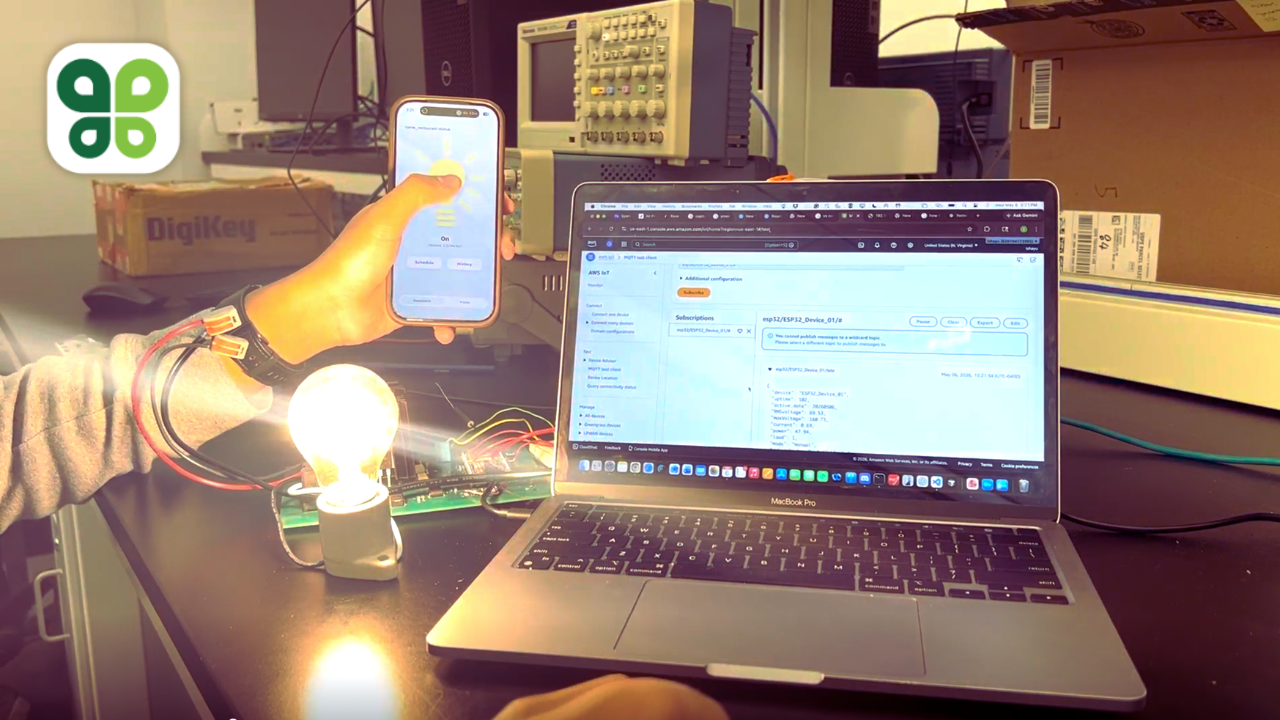
We asked UConn students to experiment and to come up with a solution to this problem: a lighting control system that could meet certain specifications in terms of cost and technical capabilities, and would also integrate seamlessly into Budderfly’s secure, AWS IoT Greengrass based platform. A team of seniors worked together and came up with an innovative lighting control solution that was presented as part of their final projects.
## The Solution
I visited the UConn campus to see the project results in person. I’ve done countless technology presentations in my career, and I know how stressful it can be. The students navigated some facility challenges and presented an impressive solution that hit all the marks.
The UConn students built a lighting control device that:
- Can survive for at least 10 years of daily use with up to 6 switches per day
- Has a wholesale cost of under $75 per device
- Can be configured for up to 6 schedule points per day using the Budderfly network
- Communicates on Wi-Fi and has an external antenna that is unobtrusive
- Operates on a schedule autonomously without need for network connectivity, once configured
- Measures current and voltage, with accuracy of 1%FS
- Has a simple LED local indicator to show if lights are running on schedule and whether they’re currently commanded on or off
- Has a mobile app that can be used to set schedules and turn lights on and off
...and meets a longer list of technical requirements we requested for optimal commercial usage.
The students’ project resulted in a commercially viable technology that solves a big problem in the energy efficiency space. It’s an inspiring example of how younger generations are helping to transform energy technology and build a more sustainable future.
*This is one example of how Budderfly is working to empower students to bring their talent to the industry. In addition to our UConn collaboration, we also have a Trade School Partnership Program that is working to bring cutting edge technologies and expertise to future technicians. Learn more about the program* [*here*](https://info.budderfly.com/school-partnerships)*.*
---
### Recent Posts
#### [5 Key Insights About How Sustainability Impacts Business Performance](https://blog.budderfly.com/new-york-climate-week-leadership-impact-forum-al-subbloie)
Oct 01, 2026 09:59:48 AM
#### [What Is Holding Back the Energy Transition? 10 Challenges Facing Building Owners](https://blog.budderfly.com/what-is-holding-back-the-energy-transition-10-challenges-facing-building-owners)
Sep 25, 2026 09:05:54 AM
#### [CapEx, Debt, or EaaS? The CFO’s Guide to Energy Upgrades](https://blog.budderfly.com/cfo-guide-off-balance-sheet-energy-upgrades-eaas)
Sep 14, 2026 10:02:49 AM
### Contact us
Email: [info@budderfly.com](mailto:info@budderfly.com)
Phone: [(855) 299-1334](tel:(855)%20299-1334)
Address: 2 Trap Falls Road, Suite 300
Shelton, CT 06484
### Get updates straight to your inbox:
Subscribe to receive regular updates straight to your inbox.
[](https://omsbdrflyprd.wpengine.com/)
2 Trap Falls Road, Suite 310
Shelton, CT 06484
[(855) 299-1334](tel:855-299-1334)
[](https://cta-redirect.hubspot.com/cta/redirect/20472728/a6496eea-1348-4b02-942b-42039cf68f2c)
-
-
-
-
- - [Energy as a Service](https://omsbdrflyprd.wpengine.com/energy-service/)
- [Who We Serve](https://omsbdrflyprd.wpengine.com/the-budderfly-effect/)
- [Resources](https://omsbdrflyprd.wpengine.com/resources/)
- [Blog](https://blog.budderfly.com/)
- - [In the News](https://news.budderfly.com/)
- [Case Studies](https://case-studies.budderfly.com/)
- [About](https://omsbdrflyprd.wpengine.com/about/)
- [Careers](https://omsbdrflyprd.wpengine.com/careers/)
[](https://www.budderfly.com/)
© 2026 Budderfly
- [Privacy Policy](https://omsbdrflyprd.wpengine.com/privacy-policy/)
- [Accessibility Statement](https://omsbdrflyprd.wpengine.com/accessibility-statement/)
- [Sitemap](https://omsbdrflyprd.wpengine.com/sitemap/)
- [Patents](https://omsbdrflyprd.wpengine.com/patents/)
[](https://cta-redirect.hubspot.com/cta/redirect/20472728/b14da822-cd99-48ce-b039-a18781490a06)
```json
{
"@context" : "https://schema.org",
"@type" : "BlogPosting",
"author" : {
"@type" : "Person",
"name" : "Budderfly",
"url" : "https://blog.budderfly.com/author/budderfly"
},
"dateModified" : "2026-05-21T13:10:27.045Z",
"datePublished" : "2026-05-21T13:10:27.000Z",
"headline" : "How UConn Students Helped Budderfly Solve Lighting Efficiency Challenges",
"image" : [ "https://blog.budderfly.com/hubfs/Blog-UConn-Project-1280x720.png" ],
"mainEntityOfPage" : {
"@id" : "https://blog.budderfly.com/uconn-students-helped-budderfly-solve-lighting-efficiency-challenges",
"@type" : "WebPage"
},
"publisher" : {
"@type" : "Organization",
"logo" : {
"@type" : "ImageObject",
"url" : "https://blog.budderfly.com/hubfs/Budderfly%20logos/Budderfly%20Logo%20w%20tage-2%20copy.png"
},
"name" : "Budderfly"
}
}
```
```json
{
"@context" : "https://schema.org",
"@type" : "FAQPage",
"mainEntity" : [ {
"@type" : "Question",
"acceptedAnswer" : {
"@type" : "Answer",
"text" : "Gyms often run long hours, have high ceilings, and carry heavy humidity loads from showers and workouts—forcing HVAC and ventilation to run harder than most businesses."
},
"name" : "Why is my gym’s electricity bill so high compared to other businesses?"
}, {
"@type" : "Question",
"acceptedAnswer" : {
"@type" : "Answer",
"text" : "Lighting can be a major slice of a gym’s energy use. LEDs cut lighting consumption significantly and reduce heat, which can also lower air-conditioning demand."
},
"name" : "How much can LED lighting actually save a fitness center?"
}, {
"@type" : "Question",
"acceptedAnswer" : {
"@type" : "Answer",
"text" : "Yes—some models (like Energy-as-a-Service) fund high-efficiency HVAC replacements upfront and are paid back through measured energy savings instead of CapEx."
},
"name" : "Can I upgrade my gym’s HVAC without a huge upfront payment?"
}, {
"@type" : "Question",
"acceptedAnswer" : {
"@type" : "Answer",
"text" : "Pools can drive energy costs due to constant filtration and heating. Variable-speed drives plus smart monitoring can reduce pump and heating energy without sacrificing comfort."
},
"name" : "How do swimming pools impact energy costs?"
}, {
"@type" : "Question",
"acceptedAnswer" : {
"@type" : "Answer",
"text" : "Peak demand charges are based on your highest usage spike in a billing cycle. Monitoring and load management can help smooth spikes and reduce demand-related costs."
},
"name" : "What are \"Peak Demand\" charges and how do gyms avoid them?"
} ]
}
```