---
title: Why Solar Makes Sense for Quick-Service Restaurants
description: QSRs use more energy per square foot than most commercial buildings. Learn how solar, HVAC, LEDs, and smart monitoring can reduce restaurant energy costs without upfront capital.
image: https://blog.budderfly.com/hubfs/Why%20Solar%20Panels%20Are.png
---
[Careers](https://omsbdrflyprd.wpengine.com/careers/)
[](https://cta-redirect.hubspot.com/cta/redirect/20472728/b14da822-cd99-48ce-b039-a18781490a06)
[](https://omsbdrflyprd.wpengine.com/)
- [Energy as a Service](https://www.budderfly.com/energy-service/)
- [Equipment](https://www.budderfly.com/energy-service/equipment/)
- [Smart Technology Monitoring](https://www.budderfly.com/our-technology/)
- [How We Innovate](https://www.budderfly.com/energy-service/how-we-innovate/)
- [Measuring & Billing Technology](https://www.budderfly.com/energy-service/measuring-billing-technology/)
- [Who We Serve](https://www.budderfly.com/the-budderfly-effect/)
- [Restaurants](https://www.budderfly.com/the-budderfly-effect/fast-casual-restaurants/)
- [Corporate & Enterprise](https://www.budderfly.com/the-budderfly-effect/enterprise/)
- [Hospitality](https://www.budderfly.com/the-budderfly-effect/hospitality/)
- [Healthcare & Fitness](https://www.budderfly.com/the-budderfly-effect/healthcare-fitness/)
- [Schools & Universities](https://www.budderfly.com/the-budderfly-effect/schools-universities/)
- [Retail](https://www.budderfly.com/the-budderfly-effect/chain-retail/)
- [Convenience Stores](https://www.budderfly.com/the-budderfly-effect/convenience-stores/)
- [Manufacturing](https://www.budderfly.com/the-budderfly-effect/manufacturing/)
- [Resources](https://blog.budderfly.com/)
- [Blog](https://blog.budderfly.com/)
- [Case Studies](https://case-studies.budderfly.com/)
- [Customer Testimonials](https://www.budderfly.com/resources/customer-testimonials/)
- [Thought Leadership](https://info.budderfly.com/)
- [News](https://news.budderfly.com/)
- [About](https://www.budderfly.com/about/)
- [Executive Team](https://www.budderfly.com/executive-team/)
- [Leadership](https://www.budderfly.com/leadership/)
- [Board of Directors](https://www.budderfly.com/board-of-directors/)
- [Mission](https://www.budderfly.com/about/mission/)
[](https://cta-redirect.hubspot.com/cta/redirect/20472728/f27e5725-ac20-4a22-8db5-60c912879eb9)
- [Energy as a Service](https://www.budderfly.com/energy-service/)
- [Equipment](https://www.budderfly.com/energy-service/equipment/)
- [Smart Technology Monitoring](https://www.budderfly.com/our-technology/)
- [How We Innovate](https://www.budderfly.com/energy-service/how-we-innovate/)
- [Measuring & Billing Technology](https://www.budderfly.com/energy-service/measuring-billing-technology/)
- [Who We Serve](https://www.budderfly.com/the-budderfly-effect/)
- [Restaurants](https://www.budderfly.com/the-budderfly-effect/fast-casual-restaurants/)
- [Corporate & Enterprise](https://www.budderfly.com/the-budderfly-effect/enterprise/)
- [Hospitality](https://www.budderfly.com/the-budderfly-effect/hospitality/)
- [Healthcare & Fitness](https://www.budderfly.com/the-budderfly-effect/healthcare-fitness/)
- [Schools & Universities](https://www.budderfly.com/the-budderfly-effect/schools-universities/)
- [Retail](https://www.budderfly.com/the-budderfly-effect/chain-retail/)
- [Convenience Stores](https://www.budderfly.com/the-budderfly-effect/convenience-stores/)
- [Manufacturing](https://www.budderfly.com/the-budderfly-effect/manufacturing/)
- [Resources](https://blog.budderfly.com/)
- [Blog](https://blog.budderfly.com/)
- [Case Studies](https://case-studies.budderfly.com/)
- [Customer Testimonials](https://www.budderfly.com/resources/customer-testimonials/)
- [Thought Leadership](https://info.budderfly.com/)
- [News](https://news.budderfly.com/)
- [About](https://www.budderfly.com/about/)
- [Executive Team](https://www.budderfly.com/executive-team/)
- [Leadership](https://www.budderfly.com/leadership/)
- [Board of Directors](https://www.budderfly.com/board-of-directors/)
- [Mission](https://www.budderfly.com/about/mission/)
[Careers](https://omsbdrflyprd.wpengine.com/careers/)
[](https://cta-redirect.hubspot.com/cta/redirect/20472728/b14da822-cd99-48ce-b039-a18781490a06)
Apr 27, 2023
# Solar for QSRs: How Restaurants Can Cut Energy Costs Without Upfront Capital
Quick-service restaurants are under growing pressure to control energy costs, protect margins, and modernize operations without adding capital burden. Solar is becoming a more practical solution for QSRs, not as a standalone upgrade, but as part of a broader, no-upfront-cost energy strategy that can reduce waste, lower utility spend, and support long-term sustainability goals.
But homeowners are not the only ones who can benefit from solar panels. QSRs can benefit from solar, but the strongest case is not solely environmental. When integrated into a broader energy strategy, solar helps restaurant operators lower utility spend, improve operational efficiency, and advance sustainability goals in a way that is practical, scalable, and easier to implement across one location or many. Budderfly has helped over 8,000 business locations across the U.S. and saved customers over $54 million in energy costs.
## QSRs Are Strong Candidates for Solar and Energy Efficiency
For QSRs, lowering emissions typically starts with lowering energy waste. Upgrades such as LED lighting, high-efficiency HVAC equipment, and smarter refrigeration controls reduce the energy required to run each location. This helps operators manage utility costs while also making progress toward franchise or corporate sustainability goals. One of our case studies shows how a multi-location KFC franchise reduced energy usage by 34% with Budderfly’s software and refrigeration enhancements. Another KFC owner saved over 206,000 kWh and over $8,891 during a pilot period, later expanding to 41 more locations.
For many QSR operators, the question is not about solar's value, but how to implement it without taking on major upfront costs or added operational complexity. The strongest results often come from combining solar with efficiency upgrades in a single, more strategic approach to energy management.
With Budderfly, QSR operators can approach solar as part of a broader energy-efficiency strategy. This makes it easier to reduce energy use and improve sustainability without taking on the full burden of a standalone project.
## **Why Solar Alone Isn’t Always Enough**
Sustainability expectations are rising across the restaurant industry, driven not only by consumers but also by franchise systems, corporate leadership, and others. That means environmental performance is a more visible part of brand alignment and long-term business strategy.
In one study, [62% of consumers](https://www.mastercard.com/news/insights/2021/consumer-attitudes-environment/) said it is more important than before for companies to operate in a sustainable and eco-friendly way. For QSRs, that pressure makes solar appealing, but lasting results typically depend on a comprehensive energy management strategy that reduces waste and ensures efficiency improvements.
Another study found that 58% of consumers want organizations to change their practices, [42% changed their buying habits based on environmental positions](https://deloitte.wsj.com/articles/consumers-expect-brands-to-address-climate-change-01618945334), and 21% encouraged others to switch brands. For QSRs, that reinforces why sustainability matters.
Solar plays an important role in a QSR’s sustainability strategy, but its impact is stronger when paired with services that reduce energy usage. By combining solar with upgrades such as high-efficiency HVAC, LED lighting, and smarter energy management, Budderfly helps lower overall consumption, increase the value of on-site renewable generation, and deliver more meaningful environmental results.
## What Installation Looks Like for QSRs
Solar installation is not limited to a single format or location. While rooftop systems are often the most familiar option, the right approach depends on each site’s layout, energy needs, and operational constraints.
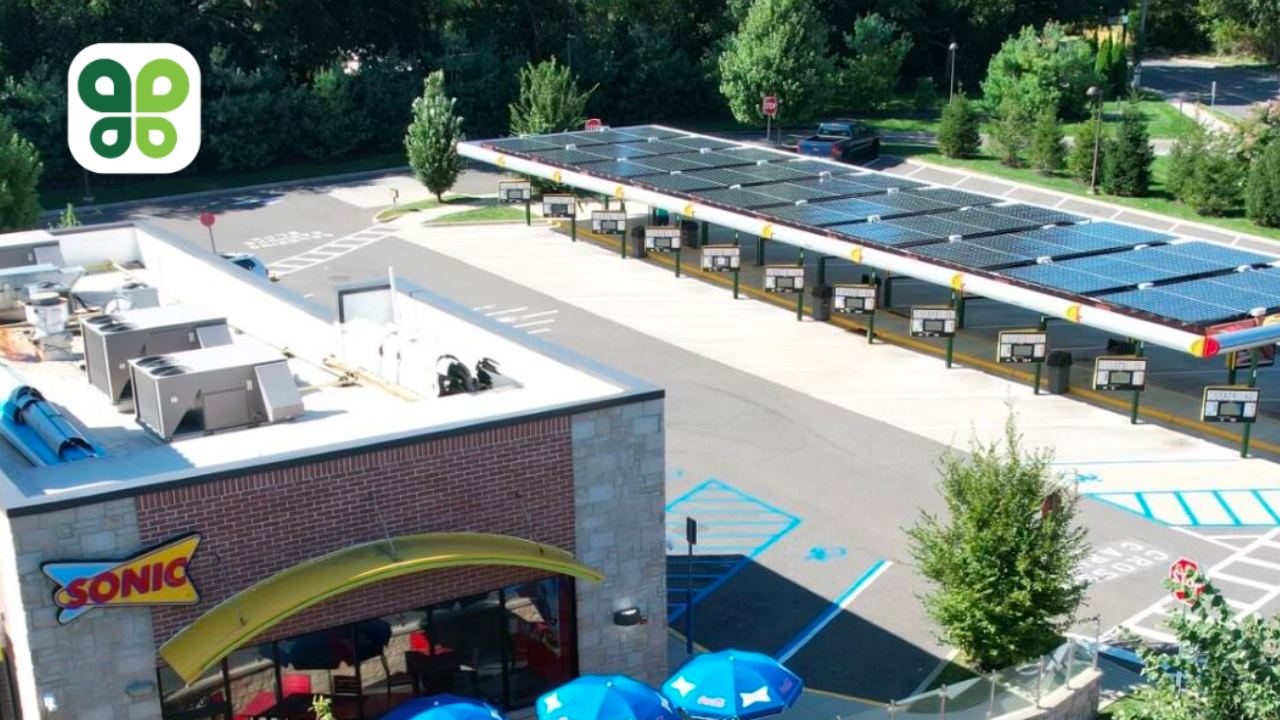
Depending on the site, QSR solar installations extend beyond the roof to include ground-mounted systems, parking canopies, or drive-thru structures. These options help operators work around roof limitations while making better use of existing space and expanding the potential value of on-site solar.
In some cases, solar infrastructure also supports future initiatives such as EV charging, giving QSR operators another way to extend the long-term value of a site improvement plan.
## The Biggest Barrier to Solar for QSRs Is Capital and Complexity
The biggest obstacle to solar for QSRs isn’t interest, but the upfront capital and execution complexity that comes with traditional projects. While costs are more manageable over time, affordability alone doesn’t solve the challenge of funding, deploying, and managing energy upgrades across restaurant locations.
In 2026, the commercial solar market continues to benefit from expanded U.S. manufacturing capacity and ongoing efforts to strengthen domestic supply chains. That broader industry momentum makes solar a more practical long-term option for businesses, even as project economics and incentive structures continue to evolve.
Even as solar becomes more affordable, the upfront cost of equipment, installation, and project management puts it out of reach for many QSR operators. That is why financing structure matters just as much as system cost when businesses evaluate whether solar is feasible.
Solar is one part of Budderfly’s broader energy solution for qualified businesses. When a QSR site is a fit based on factors such as location and building profile, Budderfly integrates solar alongside energy-efficiency upgrades. This helps operators reduce energy use and improve economics through a more comprehensive approach.
With Budderfly, qualified QSR operators can combine solar with LED lighting, high-efficiency HVAC, refrigeration controls, and advanced energy monitoring in one integrated, no-upfront-cost solution. That means lower energy use, reduced spending, and more meaningful progress toward sustainability goals without the burden of a large capital investment.
If you want to see whether your restaurant locations qualify for solar and other no-upfront-cost energy upgrades, [talk to a Budderfly energy expert](https://www.budderfly.com/lets-talk/). We can help you evaluate the right strategy for your sites and identify opportunities to reduce energy costs across your portfolio.
## **FAQ about Solar for QSRs**
### How can QSRs install solar without upfront capital?
Some providers, like Budderfly, integrate solar into a broader energy-efficiency solution that covers equipment, installation, and monitoring with no upfront cost for qualified locations.
### What types of solar installations work for QSRs?
Rooftop systems are common, but ground-mounted systems, parking canopies, and drive-thru structures are also options depending on site layout and constraints.
### Can solar be deployed across multiple restaurant locations?
Yes. Solar and energy-efficiency upgrades can be scaled across multi-location and franchise portfolios when sites meet location and building criteria.
When planned as part of a coordinated energy upgrade, installation can be scheduled to minimize disruption and reduce long-term operational complexity.
---
### Recent Posts
#### [Commercial Building Energy Storage May Be the Grid's Biggest Opportunity](https://blog.budderfly.com/commercial-building-energy-storage-grid-opportunity)
Oct 13, 2026 11:41:40 AM
#### [5 Key Insights About How Sustainability Impacts Business Performance](https://blog.budderfly.com/new-york-climate-week-leadership-impact-forum-al-subbloie)
Oct 01, 2026 09:59:48 AM
#### [What Is Holding Back the Energy Transition? 10 Challenges Facing Building Owners](https://blog.budderfly.com/what-is-holding-back-the-energy-transition-10-challenges-facing-building-owners)
Sep 25, 2026 09:05:54 AM
### Contact us
Email: [info@budderfly.com](mailto:info@budderfly.com)
Phone: [(855) 299-1334](tel:(855)%20299-1334)
Address: 2 Trap Falls Road, Suite 300
Shelton, CT 06484
### Get updates straight to your inbox:
Subscribe to receive regular updates straight to your inbox.
[](https://omsbdrflyprd.wpengine.com/)
2 Trap Falls Road, Suite 310
Shelton, CT 06484
[(855) 299-1334](tel:855-299-1334)
[](https://cta-redirect.hubspot.com/cta/redirect/20472728/a6496eea-1348-4b02-942b-42039cf68f2c)
-
-
-
-
- - [Energy as a Service](https://omsbdrflyprd.wpengine.com/energy-service/)
- [Who We Serve](https://omsbdrflyprd.wpengine.com/the-budderfly-effect/)
- [Resources](https://omsbdrflyprd.wpengine.com/resources/)
- [Blog](https://blog.budderfly.com/)
- - [In the News](https://news.budderfly.com/)
- [Case Studies](https://case-studies.budderfly.com/)
- [About](https://omsbdrflyprd.wpengine.com/about/)
- [Careers](https://omsbdrflyprd.wpengine.com/careers/)
[](https://www.budderfly.com/)
© 2026 Budderfly
- [Privacy Policy](https://omsbdrflyprd.wpengine.com/privacy-policy/)
- [Accessibility Statement](https://omsbdrflyprd.wpengine.com/accessibility-statement/)
- [Sitemap](https://omsbdrflyprd.wpengine.com/sitemap/)
- [Patents](https://omsbdrflyprd.wpengine.com/patents/)
[](https://cta-redirect.hubspot.com/cta/redirect/20472728/b14da822-cd99-48ce-b039-a18781490a06)
```json
{
"@context" : "https://schema.org",
"@type" : "BlogPosting",
"author" : {
"@type" : "Person",
"name" : "Budderfly",
"url" : "https://blog.budderfly.com/author/budderfly"
},
"dateModified" : "2026-05-29T14:41:39.676Z",
"datePublished" : "2023-04-27T14:05:54.000Z",
"headline" : "Why Solar Makes Sense for Quick-Service Restaurants",
"image" : [ "https://blog.budderfly.com/hubfs/Why%20Solar%20Panels%20Are.png" ],
"mainEntityOfPage" : {
"@id" : "https://blog.budderfly.com/solar-panels-for-qsr",
"@type" : "WebPage"
},
"publisher" : {
"@type" : "Organization",
"logo" : {
"@type" : "ImageObject",
"url" : "https://blog.budderfly.com/hubfs/Budderfly%20logos/Budderfly%20Logo%20w%20tage-2%20copy.png"
},
"name" : "Budderfly"
}
}
```
```json
{
"@context" : "https://schema.org",
"@type" : "FAQPage",
"mainEntity" : [ {
"@type" : "Question",
"acceptedAnswer" : {
"@type" : "Answer",
"text" : "Gyms often run long hours, have high ceilings, and carry heavy humidity loads from showers and workouts—forcing HVAC and ventilation to run harder than most businesses."
},
"name" : "Why is my gym’s electricity bill so high compared to other businesses?"
}, {
"@type" : "Question",
"acceptedAnswer" : {
"@type" : "Answer",
"text" : "Lighting can be a major slice of a gym’s energy use. LEDs cut lighting consumption significantly and reduce heat, which can also lower air-conditioning demand."
},
"name" : "How much can LED lighting actually save a fitness center?"
}, {
"@type" : "Question",
"acceptedAnswer" : {
"@type" : "Answer",
"text" : "Yes—some models (like Energy-as-a-Service) fund high-efficiency HVAC replacements upfront and are paid back through measured energy savings instead of CapEx."
},
"name" : "Can I upgrade my gym’s HVAC without a huge upfront payment?"
}, {
"@type" : "Question",
"acceptedAnswer" : {
"@type" : "Answer",
"text" : "Pools can drive energy costs due to constant filtration and heating. Variable-speed drives plus smart monitoring can reduce pump and heating energy without sacrificing comfort."
},
"name" : "How do swimming pools impact energy costs?"
}, {
"@type" : "Question",
"acceptedAnswer" : {
"@type" : "Answer",
"text" : "Peak demand charges are based on your highest usage spike in a billing cycle. Monitoring and load management can help smooth spikes and reduce demand-related costs."
},
"name" : "What are \"Peak Demand\" charges and how do gyms avoid them?"
} ]
}
```